Discover Love Is a Journey, the riveting story of a 33-day pope.

The “Smiling Pope” delivering his first talk
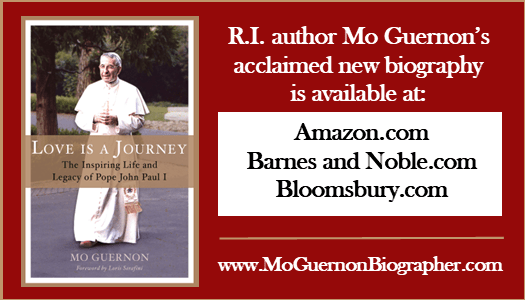
Love is a Journey: The Inspiring Life and Legacy of Pope John Paul I is the stunning story of Albino Luciani, the last Italian pope, who unexpectedly appeared on the world stage as pontiff in a surprise election in 1978. In the grand sweep of civilization, few world leaders have captured the hearts of hundreds of millions of people around the globe. John Paul I was one of them, yet until now his life’s story has remained in the shadows.
After years of conducting archival research and interviewing the pope’s nieces, personal secretaries, acquaintances, and experts, Mo Guernon has resurrected the “Smiling Pope.”
From Luciani’s harrowing birth to his shocking death, the author weaves a wondrous tale of the pope’s charisma. Revealing previously unpublished information, Guernon examines the pope’s mysterious ability to engender unprecedented affection and admiration among people of all faiths, and non-believers too, with his inimitable humility and joy.
Readers become eyewitness to the political scheming in the secret conclave of August 1978 and the Vatican plot hatched in the papal apartment to deceive the public about John Paul’s death which led to a profusion of murder conspiracy rumors that live on to this day.
John Paul I’s impact was simultaneously profound and perplexing – and until now, underappreciated. In little more than a month, he personalized and modernized the papacy while galvanizing people around the globe to embrace the conduct of virtuous lives.
The popular pope’s eulogist captured his magical influence: “He passed as a meteor which unexpectedly lights up the heavens and then disappears, leaving us amazed and astonished.”
In the concluding chapters, Guernon assesses John Paul’s legacy and journey toward sainthood as well as the beguiling question of how the Catholic Church might have evolved had his pontificate endured into the eighties.
There has never been another world leader, secular or religious, quite like him.
Table of Contents
Preface: Genesis – To Begin Anew
Prologue: Transfiguration
1. Pontiff – Week I / Charisma: A Divine Smile
2. In the Beginning: Blessed Are the Poor
3. Student and Seminarian: Austerity and Obedience
4. Priest and Promotions: Home and Away Again
5. Pontiff – Week II / Faith: Servant of Servants
6. An Intelligible Intellectual: Talented Teacher and Admired Author
7. The Reluctant Bishop: Humility
8. Patriarch and Cardinal: Preparation for the Papal Pallium
9. Pilgrimages and Prophecies: Extraordinary Encounters
10. Pontiff – Week III / Hope: God’s Promise
11. Interregnum: Out of Danger
12. Destiny: Vicar of Christ
13. Pontiff – Week IV / The Journey Nears Its End
14. The Last Supper: “See You Tomorrow, God Willing”
15. Shock: The Pope Is Dead
16. Murder Hysteria: Poison
17. Into Eternity: A Meteor That Lit Up the Heavens
Epilogue: What If?
Book Excerpts
From the Preface
“Albino Luciani could soften even the most hardened hearts. Countless people in our broken world could morally mend from knowing a man whose life embodied the triumph of love over hate, tenderness over cruelty, forgiveness over retribution, and humility over arrogance.”
From the Prologue
“…an unassuming little priest with a grand title – Patriarch of Venice – took solitary strolls on a sliver of island beach known as the Lido…”
“Daily he rose with the ascending sun to saunter along the beach, a routine he faithfully repeated as dusk approached, when he pursued the shimmering sun sliding leisurely from the heavens to caress the western horizon…”
“He could not possibly have imagined as he traced the arc of the sun each day that he would soon depart for the Vatican, never again to return home.”
From Chapter 1: Charisma
“In a flash the world would fall in love with a total stranger, though not a soul had any inkling of it. Not just yet. Smoke signals, of all things, delayed the onset of that mystifying moment.”
“At dinnertime, one of the sisters in the papal service alarmingly discovered that the kitchen cupboards were bare…Scurrying to a convent across St. Peter’s Square, the nun searched for provisions. She scooped up leftover minestrone as well as some bread, cheese, and a little wine. John Paul, an abstemious eater, contentedly dined on donated reheated soup for his first meal as pope in his new quarters.”
From Chapter 2: In the Beginning
“Albino Luciani was not born in a manger, but the place of his nativity was a meager upgrade. The primitive structure was incorporated into a hayloft. The house, such as it was in 1912, today would be considered little more than a hovel. To call it rustic would endow it with charm that its crudeness precluded. The glacial winters’ howling winds penetrated the walls of the ramshackle abode, driving its inhabitants to huddle together in a corner by the heat of their wood-burning stove, a location that became the center of family life.”
“The premature death of the second Luciani child had a chilling impact on his siblings…Albino dreaded that his brother had died because of some unspecified carelessness on his part, an unbearable burden for a three-year-old. He was persistently haunted by the thought. Berto (his brother) recalled years later about Albino: ‘He said to me that he often woke up during the night and he thought, perhaps I have been the cause of my little brother’s death’.”
From Chapter 3: Student and Seminarian
“‘I hope that when you are a priest you will take the part of the poor and the workers…’ his father wrote. It was advice that the young Luciani would forever heed. So precious was this letter to Albino that he kept it in his wallet for the remainder of his life.”
From Chapter 4: Priest and Promotions
“Luciani’s old school friend Bramezza recalled a poignant incident during World War II when Luciani came to his aid once again. ‘In 1945 I was a prisoner of war in a German concentration camp. My wife had not heard from me for over a year, and in desperation, she went to don Albino who was then teaching in the seminary. Shortly afterward, two German soldiers brought me to a radio and said, You may speak. Your wife is listening. Somehow Albino had succeeded in finding me.’ What Luciani did to secure that favor is unrecorded.”
From Chapter 5: Faith
“The pope walked down the central aisle of the cavernous Nervi Hall to the roar of attendees. Another first – no riding on a portable throne. He was grinning, always grinning, and surrounded by a sea of faithful enraptured by his presence. John Paul was greeted by twelve thousand giddy visitors hoping to catch a glimpse of the bishop in white. But he was relatively short and surrounded by bishops and monsignors, most of them taller than he. Consequently, only those fortunate enough to have an aisle seat could see him. The others strained unsuccessfully. He exchanged pleasantries and clasped the hands of hundreds (a pope shaking hands was also a novelty) in the half hour it took him to wend his way to the stage.”
“The smiling pope was breaking barriers, reaching people and teaching them. They were listening intently and responding positively. His personality drew people of all sorts to him: heads of state, high-ranking clergy, persons of other faiths, atheists and agnostics, workers, serious sinners, the disillusioned, just about everyone. Already he was changing lives for the better by his personal example, the power of his words, and the appeal of his beliefs. The possibilities for what he could accomplish in the years ahead seemed almost without limit.”
From Chapter 6: An Intelligible Intellectual
“The one book for which he is most famous is an intriguing volume titled Illustrissimi (The Illustrious Ones) that he wrote while he was Patriarch of Venice. The book is a compilation of forty imaginary letters to famous people, both real and fictitious…The book was first published in 1976 and was later translated into twelve languages – a testament to its popularity.”
“He displays a compassionate understanding of human frailty. He addresses contemporary problems with candor and self-confidence. He is always polite and considerate even to those with whom he disagrees vehemently. He uses humor freely and effectively to engage the reader.”
“The people with whom he corresponded were all famous to various degrees, and they were figures of influence in some fashion: fourteen authors, seven saints, six fictitious characters, three religious individuals, three secular leaders, two biblical luminaries, a musician, a scientist, and assorted others. The group was eclectic, including Charles Dickens, Mark Twain, King David of the Old Testament, Figaro the Barber, Pinocchio, Hippocrates, St. Luke the Evangelist, and Jesus Himself.”
From Chapter 7: The Reluctant Bishop
“‘I am the little one of once upon a time, I am the one who comes from the fields, I am pure and simple dust…I desire only to enter into your service and to put at your disposal all my poor strength, the little I have and the little I am.‘ With those touching and self-revelatory remarks, Bishop Luciani introduced himself to his new flock in the Diocese of Vittorio Veneto. The audience was taken aback. Bishops didn’t speak that way about themselves…The humility Luciani demonstrated…signaled that he would be a radically different kind of bishop.”
“The automobile in which he traveled throughout the diocese was a dinosaur, which raised some eyebrows among the faithful who were unaccustomed to seeing their bishop riding in a dilapidated vehicle. If the car was unavailable, people were startled to see Luciani using an even more lowly means of transportation: ‘On days when there were some problems, and he did not want to miss a pastoral visit in a parish, he went by bicycle,’ recalled Pia.” (the Pope’s niece)
“As he prepared to leave for his new assignment, Luciani turned over to the diocesan vicar general his total personal savings. A sizable crowd wishing to see him off assembled on the day of his departure. They presented him with a substantial sum of money they had raised in small contributions…Luciani…offered his thanks…for their generosity but refused to accept their largesse. Give it to the poor, he insisted. ‘I came to you owning nothing, and I want to leave you owning nothing’.”
From Chapter 8: Patriarch and Cardinal
“The Patriarch almost always dressed in a black cassock. Luciani enjoyed wandering the streets of Venice…appearing as a simple priest…After one such solitary stroll, the Patriarch returned home sporting a bruised and swollen cheek. When a sister asked him what had happened, he replied dispassionately, ‘Oh, nothing…I met a drunkard…He hit me in the face’.”
“Luciani wanted to ‘demythologize’ the role of bishop. That is why he typically appeared in public dressed in black.”
“When traveling in the city of canals, he patiently waited in line to take the vaporetto (a water taxi) with ordinary people until his turn came to board.”
“Not long after coming to Venice, he shocked some people by selling various treasures of the archdiocese…so that he could make a contribution…to a sanitarium for children with handicaps…He thought the Church itself…had failed in some respects in its obligations to the needy.”
From Chapter 9: Pilgrimages and Prophecies
“According to one widely circulated account whose source remains unknown, the informal session between the two religious figures was shocking, even eerie. The poised visionary greeted him as ‘Holy Father.’ Luciani was unnerved by this puzzling salutation. Was Sr. Lucia hallucinating? Was it a case of mistaken identity? Both were highly unlikely. According to one account, Luciani later told a Venetian theologian that the sister had predicted that he would become pope.”
On a trip to Burundi: “True to his reputation for being unpretentious, he accompanied one of the missionaries, riding in a jeep. When the vehicle sank in mud on one occasion, Luciani jumped out and helped push it out of the quagmire…The rampant poverty tore at his heart. He toured a leper colony…and wrote about it. ‘In this place a European has difficulty holding back tears…a number of children were completely naked,’ he lamented.”
From Chapter 10: Hope
“He had been an immediate sensation, and his personal popularity, without regard to religious denomination, was intensifying and expanding far beyond the boundaries of the Western world. The international press corps that covered the papacy was beguiled by him. The cardinals who had elected him continued to be effusive about their choice. Seemingly all who met with him were touched by his meekness, impressed with his wisdom, delighted with the prospects of a revitalized church under his leadership. Cardinal Carlo Confalonieri provided proof of the public’s esteem of John Paul: ‘St. Peter’s square was jammed to the brim for the noon blessing the past two Sundays – something that had occurred only very seldom previously’.”
“Banished were the regal flourishes, the imperious language, the staid formality that had characterized it (the papacy) as an outworn relic of a bygone time. This unassuming pastor, this champion of the poor, this servant of servants, this human font of joy and charity was rejuvenating the Church, making it relevant and appealing to a world gone astray.”
“In talking about the importance of cheerfulness, he shared with the audience a story he once told his students, and he brought down the house in doing so. A mason, he said, plunged from a second story scaffolding and broke both legs. When arriving at the hospital, the attending nun said, ‘You poor man! You hurt yourself when you fell.’ ‘No, Mother,’ the injured man responded, ‘when I hit the ground, that’s when I hurt myself’.”
From Chapter 11: Interregnum
“…an NBC news reporter contacted Luciani to request biographical information in the event of his election…Casually dismissing his chances and using self-deprecating humor, Luciani asserted, ‘You can’t make gnocchi out of this dough’.”
“The night before the conclave was to begin, Luciani engaged in a conversation with a member of the papal guard named Camillo Cibin, a man Luciani knew…Cibin greeted Luciani with, ‘Let me wish you every success, your Eminence…’ ‘You are wishing me misfortune!’ replied the Cardinal half in jest. ‘…there is nothing to be worried about; it’s not for me’.”
From Chapter 12: Destiny
“As the electors exited the chapel to gather for lunch, Cardinal Lazlo Lekai, archbishop of Esztergom, Hungary, observed, ‘I remember that…we met Patriarch Luciani in the elevator. Then we told him: The votes are increasing. He shielded himself saying: This is only a summer shower. At one point Cardinal Jaime Sin asked Luciani the location of a toilet. When the patriarch responded that he didn’t know, Sin teased, ‘But you will know soon because you are going to be the owner of this house.’ ‘Are you a prophet?’ Luciani replied nervously.”
“When Cardinal Suenens expressed his gratitude for Luciani’s acceptance, the pope wistfully responded, ‘Maybe I should have said no.’ As Jaime Sin of Manila who had earlier in the day told Luciani, ‘I am sure you will be the new pope’ approached, Luciani said to him, ‘You were a prophet, your Eminence! But my pontificate will be short.”
From Chapter 13: Love
“…the pope addressed the difficulty of his job, self-effacingly admitting, ‘Although I have already been a bishop for twenty years…I confess that I have not yet really learned my trade.’ In Rome he would try to follow the advice of St. Gregory the Great, who had written, ‘Let the pastor be close to each of his subjects with compassion, forgetting his rank, let him consider himself the equal of his good subjects’.”
“The pope delivered his final Angelus on this day from the window of his study. He spoke with passion to the masses assembled in the square. He cited with poignancy the incident of the homicide involving a Roman student that had taken place a few days before and talked about how only love can conquer violence. He also lamented the kidnapping of Luca Locci, a seven-year-old who had been held hostage for three months. The very next day, the young victim was released to the relieved parents, who publicly thanked John Paul for having secured the boy’s freedom.”
“He spoke cogently without relying on a text, notes, or even a crude outline; and the complexity of thought, the profusion of ideas flowed smoothly, coherently, and with unity like the harmony of a symphony. His normally weak voice was unusually strong, and the delivery of his speech was ablaze with fervor…His countenance glowed; his eyes danced.”
“…a man in the audience, an admirer, interrupted the pope. ‘May you enjoy a long life!’ he shouted. The audience burst into applause. Appearing slightly embarrassed, the pope smiled briefly, said, ‘Okay,’ waved his right hand in a gesture meant to stifle the approbation, as if to signal, ‘Enough of this.’ Then, while the acclamation continued, he looked down, pressing his fingers, his smile suddenly vanishing into a grave expression. It lasted a mere moment before he resumed his talk, but something was strangely somber about his reaction. The next day he would be dead.”
From Chapter 14: The Last Supper
“Something was amiss in the papal household…The day started unremarkably enough, much like the previous thirty-two, but events went awry beginning in the early afternoon, and nothing was normal after that.”
“Despite the ongoing gossip among some Vatican administrators that John Paul was not up to the job of the papacy, one Roman church official made an observation at odds with the criticism. ‘It was almost as though his first month had given him a feel for the Vatican. He suddenly seemed to be enjoying it.’ Magee validated the assessment. ‘He was gradually fitting into and getting to know…what was expected of him.’ Referring to the pope’s death, Magee asserted, ‘[T]hings were looking up when that happened’.”
“Before turning in for the night, John Paul thanked the sisters for dinner and bid them a good evening. Observing the Pope take his leave, Sr. Margherita recalled, ‘He went alone to his room as usual…after he said goodnight to us, the Holy Father stood at the door of his study, turned around again and waved goodnight to us, smiling…I can still see him there at the door. It is the last image I have of him’.”
“Before entering his bedroom for the final time, John Paul uttered his last words; they were addressed to the nuns who cared for him…’A domani se Dio vuole,’ (See you tomorrow, God willing.) he said with a soft smile. He then climbed into bed with papers in his hand – still more work to be done. Shortly thereafter he slipped into eternal sleep. Alone. Utterly alone. For him there would be no tomorrow.”
From Chapter 15: Shock
“The apostolic palace, a massive building rising above the lofty columns of Bernini’s colonnade, was cast in deep shadow while the piazza itself was spectacularly illuminated, the waters of the fountain dancing with life. Around midnight a security officer patrolling the square noticed that one third-floor window still shone. He expected that in another hour or so the pope’s bedchamber would be darkened like all the others in the complex. He, like the taxi drivers in the vicinity, assumed that John Paul was working late. But the night lapsed into dawn, and the room remained unexpectedly illumined, puzzling the guards in the square who speculated that the pope must have fallen asleep with the lights on.”
“A few days prior to his death, the Pope’s personal doctor, Antonio Da Ros, had met with the Pontiff at the Vatican and described his health as good. Nevertheless, the doctor expressed a note of concern: ‘But the stress of his new post was great. He perhaps was not prepared, accustomed to that responsibility. I told him he could not continue at that pace, and he replied he could not do anything about it’.”
“John Paul himself had a premonition that can’t be readily dismissed because he shared it with Fr. John Magee, who remembered that the pope had told him he would be succeeded by ‘a foreigner’ who had been seated right across from him during the conclave. Years later, while Magee was rummaging through a closet in the apostolic palace where he served John Paul’s successor, he came across a seating chart of the conclave that elected Luciani. Seated across from him was Poland’s Karol Wojtyla. (John Paul II).”
From Chapter 16: Murder Hysteria
“Suspicion was stirring about the official cause of the beloved pope’s death. Virulent rumors that he had been assassinated spread within hours of the Vatican’s public announcement of the Pontiff’s passing. Before long, skepticism swept the rest of the world.”
“The popular pope’s passing was too sudden and too traumatizing to be comprehensible. John Paul was only sixty-five years old. In his public appearance just the day before his death he had exuded vitality. He had been animated and joyful. He had laughed good-naturedly while delivering a stirring talk. He had looked and sounded like a healthy, cheerful man. Further, there had been no public disclosure or discussion about any preexisting physical ailment prior to or after his election.”
“John Paul I has long been laid to rest, but the falsehoods about his death live on.”
From Chapter 17: Into Eternity
“John Paul’s body was held aloft on the broad shoulders of his pallbearers. Some in the audience took pictures as the body passed by them as morbid mementos of the occasion. The Pope’s masklike face was as white as a ghost’s, drained of all color. It bore no trace of a smile. As the men carrying the body walked forward in lock step, the body swayed slightly from side to side like the movement of a cradle.“
“The outpouring of love for John Paul inspired awe. Braving steady, heavy rain, hordes of shocked and sodden people waited for hours without complaint for their turn to say a final goodbye…The endless lines were still forming until just before the body was placed in the coffin to be carried outdoors for the funeral ceremony. The Catholic Herald estimated that as many as 850,000 people paid their respects before the viewing concluded.”
From the eulogy of John Paul I by Cardinal Carlo Confalonieri: “We ask ourselves, why so quickly? Yet one month was enough for him to have conquered hearts…He passed as a meteor which unexpectedly lights up the heavens and then disappears, leaving us amazed and astonished.”
From the Epilogue
“Albino Luciani’s simplicity had such nobility that his meekness helped make people more compassionate. His embodiment of love, the source of his unmitigated joy, transfixed a world starving for harmony. His life was so exemplary that it ennobled a globe grown weary and cynical…”
Email: MoGuernon@gmail.com
All photos of the Pope appearing on this website are used with permission, courtesy of Fondazione Papa Luciani Museum Collection.
 Love Is a Journey: The Inspiring Life and Legacy of Pope John Paul I